Getting Started with OneMax
This tutorial explains how to implement custom representations with the following components:
Individual as the binary string representation.
Variator as the random bit mutator which modifies each bit of the binary string with a fixed probability.
Evaluator as the bit distance evaluator which sums all bits in a bit string.
Put Everything Together runs an evolutionary algorithm using the operators defined above, in addition to a stock selector.
Typically, these components are required to solve an optimisation problem: (a) the individual represents solutions, (b) the variator must know the representation to change it, and (c) the evaluator assesses how the individual solves the problem.
Individual
All custom representations must derive evokit.core.population.Individual.
At minimum, the implementation must do the following:
Initialise
.genometo store the representation.Override
.copy(..)to return an independent copy.
The implementation must decide how to initialise new individuals. In this example, the class BinaryString implements a factory method BinaryString.random(..), which creates a uniformly random bit string of the given length.
[1]:
from __future__ import annotations
from typing import Self
from typing import override
[2]:
from random import getrandbits
from evokit.core import Individual

class BinaryString(Individual[list[int]]):
    @override
    def __init__(self, value: list[int]) -> None:
        """Required.

        Initialise the genome.
        """
        self.genome: list[int] = value

    @override
    def copy(self: Self) -> Self:
        """Required.

        Ensure that operations performed on
        a copy do not affect to the original individual.
        """
        return type(self)(self.genome.copy())

    @staticmethod
    def random(len: int) -> BinaryString:
        """Not required.

        Initialise a random individual.
        """
        return BinaryString(
            (len * [0] +
                [int(digit)
                 for digit in bin(getrandbits(len))[2:]])[-len:]
        )

    @override
    def __str__(self: Self) -> str:
        """Not required.

        Return a text representation of the individual.
        """
        return str(self.genome)
Variator
All custom variators must derive evokit.core.variator.Variator.
At minimum, the implementation must do the following:
Initialise
.arityto specify how many parents are passed to.vary.Override
.vary(..)method to specify how to create new individuals from existing ones. Be sure to call.copybefore making changes to an existing individual.
In this example, .vary receives an 1-tuple because .arity=2.
[3]:
from random import random
from typing import Sequence

from evokit.core import Variator

class RandomBitMutator(Variator[BinaryString]):
    @override
    def __init__(self, mutation_rate: float):
        self.arity = 1

        # Not required. Raise an error if the mutation rate is too big or small.
        if (mutation_rate < 0 or mutation_rate > 1):
            raise ValueError(f"Mutation rate must be within {0} and {1}."
                             f"Got: {mutation_rate}")

        # The mutation rates is a parameter of the variator.
        self.mutation_rate = mutation_rate

    @override
    def vary(self, parents: Sequence[BinaryString]) -> tuple[BinaryString,
                                                             BinaryString]:
        """Required.

        Produce new individuals from existing ones.

        Because `.arity=1` in the initialiser, `parents` will be a 1-tuple at runtime.
        """
        offspring = parents[0].copy()

        for i in range(0, len(offspring.genome)):
            if (random() < self.mutation_rate):
                offspring.genome[i] = 1 if offspring.genome[i] == 0 else 1

        return (offspring, parents[0].copy())
Evaluator
All custom evaluators must derive evokit.core.evaluator.Evaluator.
At minimum, the implementation must override the .evaluate(..) method. This method should take one individual of the correct type, then return its fitness(es) in a tuple.
The .evaluate_population(..) method, which is not covered here, applies .evaluate(..) to each
In this example, .evaluate(..) returns a 1-tuple because it uses only one measure of fitness. The method sums all bits in the .genome of a BinaryString.
[4]:
from evokit.core import Evaluator
from typing import override

class BitDistanceEvaluator(Evaluator[BinaryString]):
    @override
    def evaluate(self, individual: BinaryString) -> tuple[float]:
        return (sum(individual.genome),)
Put Everything Together
Construct an evolutionary algorithm with components defined above, in addition to a stock selector evolvables.selectors.TruncationSelector (see the Selector Tutorial for how to construct it) and a stock algorithm evolvables.algorithms.SimpleLinearAlgorithm (see the Algorithm Tutorial for how to make your own). Selectors are algorithms are independent to problem and solution representations.
This example also use an elitist (hall-of-fame) truncation selector. This is done by wrapping the selector with Elitist (see the Interceptor Tutorial for more information).
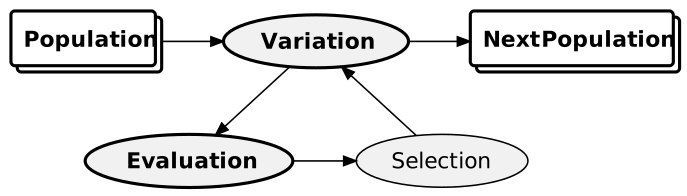
Each step of the algorithm includes the following operations:
evaluatethepopulationselectfrompopulationthen,
updatepopulationwith the result
varypopulationthen,
updatethepopulationwith the result
[5]:
from evokit.evolvables.selectors import Elitist, TruncationSelector
from evokit.evolvables.algorithms import SimpleLinearAlgorithm
Initialise Population
The algorithm should begin with a pool of candidate solutions. Create a number of BinaryString instances, then store them in a Population. This is the initial population.
[6]:
from evokit.core import Population

BINSTRING_LENGTH: int = 1000
POPULATION_SIZE: int = 20
GENERATION_COUNT: int = 100
init_pop = Population[BinaryString]()

for i in range(0, POPULATION_SIZE):
    init_pop.append(BinaryString.random(BINSTRING_LENGTH))
Define the Algorithm
Initialise operators, then initialise the algorithm with these operators. Everything has already been defined or imported, so using them is easy.
[7]:
ctrl: SimpleLinearAlgorithm[BinaryString] =\
        SimpleLinearAlgorithm[BinaryString](
    population=init_pop,
    variator=RandomBitMutator(0.1),
    selector=Elitist(TruncationSelector[BinaryString](POPULATION_SIZE)),
    evaluator = BitDistanceEvaluator()
)
Run the Algorithm
Run the algorithm, then record the best individual of each generation. Be sure call copy, so that the retained individual is not affected by operations on the original.
[8]:
bests: list[BinaryString] = []

for _ in range(GENERATION_COUNT):
    ctrl.step()
    bests.append(ctrl.population.best().copy())
Analyse Results
As bests records highest-fitness individuals of each generation, its last item should have higher fitness than the first. Observe the difference:
[9]:
print(f"Best individual of the first generation is {bests[0]}")
print(f"    with fitness {sum(bests[0].genome)}")
print(f"Best individual of the last generation is {bests[-1]}")
print(f"    with fitness {sum(bests[-1].genome)}")
Best individual of the first generation is [0, 1, 0, 1, 1, 0, 1, 0, 0, 0, 1, 0, 1, 0, 1, 1, 1, 1, 1, 1, 0, 1, 0, 0, 1, 0, 1, 0, 0, 1, 0, 0, 0, 0, 1, 1, 1, 1, 0, 1, 1, 1, 1, 0, 0, 1, 1, 0, 1, 1, 1, 1, 0, 1, 0, 1, 0, 0, 1, 1, 0, 1, 0, 1, 0, 0, 1, 1, 1, 0, 0, 1, 1, 1, 1, 0, 0, 1, 0, 0, 1, 1, 0, 1, 1, 1, 0, 0, 1, 1, 1, 1, 0, 1, 1, 1, 0, 0, 0, 0, 1, 1, 1, 0, 1, 0, 1, 0, 1, 0, 0, 1, 0, 1, 1, 0, 1, 1, 1, 1, 1, 1, 1, 0, 0, 0, 1, 0, 1, 1, 1, 0, 1, 1, 1, 0, 0, 1, 1, 0, 0, 1, 1, 1, 0, 1, 0, 1, 1, 0, 1, 0, 0, 1, 0, 1, 1, 1, 1, 0, 1, 0, 1, 0, 1, 1, 0, 1, 1, 0, 0, 1, 1, 1, 0, 1, 0, 0, 1, 0, 1, 1, 1, 0, 1, 1, 0, 0, 0, 1, 1, 0, 1, 0, 1, 0, 1, 0, 0, 1, 1, 1, 1, 0, 1, 0, 1, 0, 0, 1, 1, 0, 1, 1, 1, 0, 0, 0, 1, 0, 1, 0, 0, 0, 0, 1, 1, 0, 1, 1, 0, 1, 0, 1, 1, 1, 1, 0, 1, 1, 1, 1, 1, 0, 0, 1, 1, 1, 1, 1, 1, 1, 1, 0, 1, 0, 0, 0, 0, 1, 0, 1, 0, 1, 0, 0, 0, 0, 0, 1, 1, 1, 1, 1, 0, 0, 1, 1, 0, 1, 0, 1, 1, 1, 0, 1, 0, 0, 1, 1, 1, 1, 0, 1, 0, 1, 1, 1, 1, 1, 0, 1, 1, 1, 1, 1, 1, 1, 0, 0, 0, 1, 1, 1, 1, 1, 0, 0, 1, 1, 1, 0, 0, 1, 0, 1, 1, 0, 0, 1, 1, 0, 0, 0, 1, 0, 0, 1, 1, 0, 1, 1, 1, 0, 0, 1, 0, 1, 1, 1, 1, 0, 1, 1, 1, 1, 0, 0, 0, 0, 1, 1, 1, 0, 0, 1, 0, 1, 1, 1, 1, 1, 1, 0, 0, 1, 1, 1, 0, 0, 1, 0, 0, 1, 0, 1, 0, 0, 1, 0, 1, 1, 0, 1, 1, 0, 1, 0, 0, 1, 1, 1, 1, 1, 1, 1, 0, 1, 0, 0, 0, 1, 1, 0, 1, 0, 0, 1, 0, 0, 0, 1, 1, 0, 0, 0, 1, 1, 0, 1, 0, 1, 1, 1, 0, 0, 1, 1, 1, 1, 1, 0, 1, 0, 0, 1, 0, 1, 1, 0, 1, 0, 1, 1, 0, 0, 0, 1, 1, 1, 0, 0, 0, 0, 0, 1, 0, 1, 0, 1, 1, 1, 0, 1, 1, 1, 0, 0, 1, 1, 1, 1, 1, 0, 0, 0, 1, 0, 1, 1, 0, 0, 0, 1, 0, 0, 1, 0, 1, 1, 1, 1, 1, 1, 1, 0, 1, 0, 0, 1, 0, 0, 0, 1, 1, 1, 0, 1, 1, 1, 1, 1, 1, 0, 0, 0, 0, 0, 0, 0, 1, 0, 1, 1, 1, 1, 1, 0, 1, 0, 0, 1, 0, 1, 1, 1, 0, 0, 0, 0, 0, 1, 1, 1, 0, 1, 1, 1, 1, 1, 1, 1, 0, 1, 1, 0, 1, 1, 1, 0, 1, 1, 0, 1, 1, 0, 1, 1, 0, 0, 0, 1, 1, 0, 0, 1, 0, 1, 0, 0, 0, 0, 0, 0, 1, 0, 1, 1, 0, 0, 0, 0, 1, 1, 0, 0, 0, 1, 1, 1, 0, 0, 1, 1, 0, 0, 0, 0, 0, 1, 1, 1, 1, 1, 1, 1, 0, 1, 1, 1, 0, 1, 0, 0, 1, 1, 1, 1, 1, 1, 1, 0, 1, 1, 0, 1, 0, 0, 1, 0, 1, 0, 0, 1, 0, 0, 0, 1, 0, 1, 0, 0, 1, 1, 1, 1, 1, 1, 0, 1, 0, 0, 0, 0, 1, 0, 0, 0, 1, 0, 1, 0, 1, 0, 1, 0, 1, 0, 1, 1, 0, 0, 0, 1, 0, 1, 1, 1, 1, 1, 1, 1, 1, 1, 0, 0, 0, 0, 1, 1, 0, 0, 0, 1, 1, 1, 1, 1, 1, 1, 1, 0, 1, 0, 1, 0, 1, 1, 1, 1, 1, 1, 1, 0, 1, 0, 0, 0, 1, 1, 0, 0, 1, 1, 0, 0, 1, 1, 1, 1, 0, 1, 1, 0, 1, 1, 1, 1, 0, 1, 0, 1, 0, 0, 1, 1, 0, 1, 1, 1, 0, 1, 1, 1, 1, 0, 0, 1, 1, 1, 1, 0, 1, 1, 1, 0, 1, 1, 1, 1, 0, 1, 1, 0, 1, 1, 1, 0, 0, 1, 1, 0, 0, 1, 1, 1, 1, 0, 1, 0, 1, 0, 1, 1, 1, 0, 0, 1, 1, 0, 0, 0, 1, 0, 1, 0, 1, 0, 1, 1, 0, 0, 1, 1, 1, 0, 0, 0, 1, 1, 0, 0, 1, 0, 1, 1, 0, 0, 0, 0, 1, 1, 1, 1, 1, 1, 0, 1, 1, 1, 1, 1, 0, 1, 0, 0, 1, 1, 1, 0, 1, 1, 0, 0, 0, 1, 1, 0, 0, 0, 1, 1, 1, 1, 0, 1, 0, 1, 0, 1, 1, 0, 1, 0, 1, 1, 1, 1, 1, 0, 1, 1, 1, 1, 1, 0, 1, 0, 1, 1, 0, 0, 0, 1, 0, 0, 1, 1, 0, 1, 1, 1, 1, 1, 0, 0, 1, 1, 1, 0, 1, 1, 0, 0, 0, 0, 1, 0, 0, 1, 0, 1, 0, 1, 1, 0, 1, 1, 0, 1, 0, 1, 1, 0, 0, 0, 1, 1, 1, 1, 0, 0, 1, 0, 1, 0, 0, 0, 0, 1, 1, 0, 1, 1, 1, 1, 1, 0, 1, 0, 1, 0, 1, 1, 0, 1, 0, 1, 0, 0, 0, 0, 0, 1, 1, 1, 1, 1, 1, 1]
    with fitness 577
Best individual of the last generation is [1, 1, 1, 1, 1, 1, 1, 1, 1, 1, 1, 1, 1, 1, 1, 1, 1, 1, 1, 1, 1, 1, 1, 1, 1, 1, 1, 1, 1, 1, 1, 1, 1, 1, 1, 1, 1, 1, 1, 1, 1, 1, 1, 1, 1, 1, 1, 1, 1, 1, 1, 1, 1, 1, 1, 1, 1, 1, 1, 1, 1, 1, 1, 1, 1, 1, 1, 1, 1, 1, 1, 1, 1, 1, 1, 1, 1, 1, 1, 1, 1, 1, 1, 1, 1, 1, 1, 1, 1, 1, 1, 1, 1, 1, 1, 1, 1, 1, 1, 1, 1, 1, 1, 1, 1, 1, 1, 1, 1, 1, 1, 1, 1, 1, 1, 1, 1, 1, 1, 1, 1, 1, 1, 1, 1, 1, 1, 1, 1, 1, 1, 1, 1, 1, 1, 1, 1, 1, 1, 1, 1, 1, 1, 1, 1, 1, 1, 1, 1, 1, 1, 1, 1, 1, 1, 1, 1, 1, 1, 1, 1, 1, 1, 1, 1, 1, 1, 1, 1, 1, 1, 1, 1, 1, 1, 1, 1, 1, 1, 1, 1, 1, 1, 1, 1, 1, 1, 1, 1, 1, 1, 1, 1, 1, 1, 1, 1, 1, 1, 1, 1, 1, 1, 1, 1, 1, 1, 1, 1, 1, 1, 1, 1, 1, 1, 1, 1, 1, 1, 1, 1, 1, 1, 1, 1, 1, 1, 1, 1, 1, 1, 1, 1, 1, 1, 1, 1, 1, 1, 1, 1, 1, 1, 1, 1, 1, 1, 1, 1, 1, 1, 1, 1, 1, 1, 1, 1, 1, 1, 1, 1, 1, 1, 1, 1, 1, 1, 1, 1, 1, 1, 1, 1, 1, 1, 1, 1, 1, 1, 1, 1, 1, 1, 1, 1, 1, 1, 1, 1, 1, 1, 1, 1, 1, 1, 1, 1, 1, 1, 1, 1, 1, 1, 1, 1, 1, 1, 1, 1, 1, 1, 1, 1, 1, 1, 1, 1, 1, 1, 1, 1, 1, 1, 1, 1, 1, 1, 1, 1, 1, 1, 1, 1, 1, 1, 1, 1, 1, 1, 1, 1, 1, 1, 1, 1, 1, 1, 1, 1, 1, 1, 1, 1, 1, 1, 1, 1, 1, 1, 1, 1, 1, 1, 1, 1, 1, 1, 1, 1, 1, 1, 1, 1, 1, 1, 1, 1, 1, 1, 1, 1, 1, 1, 1, 1, 1, 1, 1, 1, 1, 1, 1, 1, 1, 1, 1, 1, 1, 1, 1, 1, 1, 1, 1, 1, 1, 1, 1, 1, 1, 1, 1, 1, 1, 1, 1, 1, 1, 1, 1, 1, 1, 1, 1, 1, 1, 1, 1, 1, 1, 1, 1, 1, 1, 1, 1, 1, 1, 1, 1, 1, 1, 1, 1, 1, 1, 1, 1, 1, 1, 1, 1, 1, 1, 1, 1, 1, 1, 1, 1, 1, 1, 1, 1, 1, 1, 1, 1, 1, 1, 1, 1, 1, 1, 1, 1, 1, 1, 1, 1, 1, 1, 1, 1, 1, 1, 1, 1, 1, 1, 1, 1, 1, 1, 1, 1, 1, 1, 1, 1, 1, 1, 1, 1, 1, 1, 1, 1, 1, 1, 1, 1, 1, 1, 1, 1, 1, 1, 1, 1, 1, 1, 1, 1, 1, 1, 1, 1, 1, 1, 1, 1, 1, 1, 1, 1, 1, 1, 1, 1, 1, 1, 1, 1, 1, 1, 1, 1, 1, 1, 1, 1, 1, 1, 1, 1, 1, 1, 1, 1, 1, 1, 1, 1, 1, 1, 1, 1, 1, 1, 1, 1, 1, 1, 1, 1, 1, 1, 1, 1, 1, 1, 1, 1, 1, 1, 1, 1, 1, 1, 1, 1, 1, 1, 1, 1, 1, 1, 1, 1, 1, 1, 1, 1, 1, 1, 1, 1, 1, 1, 1, 1, 1, 1, 1, 1, 1, 1, 1, 1, 1, 1, 1, 1, 1, 1, 1, 1, 1, 1, 1, 1, 1, 1, 1, 1, 1, 1, 1, 1, 1, 1, 1, 1, 1, 1, 1, 1, 1, 1, 1, 1, 1, 1, 1, 1, 1, 1, 1, 1, 1, 1, 1, 1, 1, 1, 1, 1, 1, 1, 1, 1, 1, 1, 1, 1, 1, 1, 1, 1, 1, 1, 1, 1, 1, 1, 1, 1, 1, 1, 1, 1, 1, 1, 1, 1, 1, 1, 1, 1, 1, 1, 1, 1, 1, 1, 1, 1, 1, 1, 1, 1, 1, 1, 1, 1, 1, 1, 1, 1, 1, 1, 1, 1, 1, 1, 1, 1, 1, 1, 1, 1, 1, 1, 1, 1, 1, 1, 1, 1, 1, 1, 1, 1, 1, 1, 1, 1, 1, 1, 1, 1, 1, 1, 1, 1, 1, 1, 1, 1, 1, 1, 1, 1, 1, 1, 1, 1, 1, 1, 1, 1, 1, 1, 1, 1, 1, 1, 1, 1, 1, 1, 1, 1, 1, 1, 1, 1, 1, 1, 1, 1, 1, 1, 1, 1, 1, 1, 1, 1, 1, 1, 1, 1, 1, 1, 1, 1, 1, 1, 1, 1, 1, 1, 1, 1, 1, 1, 1, 1, 1, 1, 1, 1, 1, 1, 1, 1, 1, 1, 1, 1, 1, 1, 1, 1, 1, 1, 1, 1, 1, 1, 1, 1, 1, 1, 1, 1, 1, 1, 1, 1, 1, 1, 1, 1, 1, 1, 1, 1, 1, 1, 1, 1, 1, 1, 1, 1, 1, 1, 1, 1, 1, 1, 1, 1, 1, 1, 1, 1, 1, 1, 1, 1, 1, 1, 1, 1, 1, 1, 1, 1, 1, 1, 1, 1, 1, 1, 1, 1, 1, 1, 1, 1, 1, 1, 1, 1, 1, 1, 1, 1, 1, 1, 1, 1, 1, 1, 1, 1, 1, 1, 1, 1, 1, 1, 1, 1, 1, 1, 1, 1, 1, 1, 1, 1, 1, 1, 1, 1, 1, 1, 1, 1, 1, 1, 1, 1, 1, 1, 1, 1, 1, 1, 1, 1, 1, 1, 1, 1, 1, 1, 1, 1, 1, 1, 1, 1, 1, 1, 1, 1, 1, 1, 1, 1, 1, 1, 1, 1, 1, 1, 1, 1, 1, 1, 1, 1, 1, 1, 1, 1, 1, 1, 1, 1, 1, 1, 1, 1]
    with fitness 1000
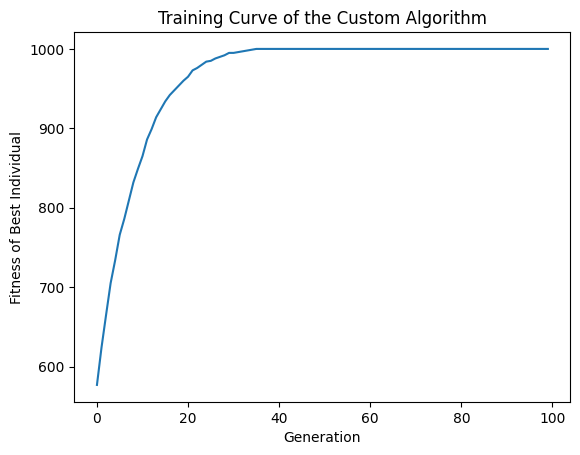
Plot the training curve, note that the increase in fitness slows down near convergence.
For EvoKit’s specialised data collection and reporting module, see the Accountant Tutorial.
[10]:
# type: ignore[reportUnknownMemberType]
from matplotlib import pyplot as plt

plt.title('Training Curve of the Custom Algorithm')
plt.xlabel('Generation')
plt.ylabel('Fitness of Best Individual')
plt.plot([i for i in range(len(bests))], [sum(x.genome) for x in bests])
plt.show()